

Women’s Month Spotlight: Green Entrepreneur and EMA Board Member Karen Behnke
The environmental movement has a long history of incredible women taking initiative and doing their part to ensure a healthier and more sustainable future. Few fit that mold better than EMA Corporate Board Member Karen Behnke, who revolutionized organic beauty care and is set to do it again! Karen has gone above and beyond to support EMA’s mission, and we are honored to turn the spotlight on her for this exclusive interview.
1. First off, EMA is so grateful to you for all your support. What about EMA’s message inspired you to get involved?
Having been an environmentalist for decades, I’ve supported many nonprofit organizations, but EMA stands out in a powerful way. I love that EMA drives environmental action through entertainment and storytelling. Movies, television, and pop culture often influence how people think, and EMA has found a way to use that power to create real, measurable change.
Secondly, I also felt an immediate alignment with Debbie Levin’s pioneering work. As someone who helped push the beauty industry toward organic and sustainable practices long before it was mainstream, I know how hard it is to create change within an industry. EMA has done that for entertainment. I’ve helped pioneer that for beauty. And I love that EMA engages multiple generations—just as I’ve always done with my brands. We need the wisdom, contacts and perspective of those of us 50+ and the energy, ideas and creativity of younger leaders. EMA’s Young Hollywood Board is a brilliant example of that multigenerational impact.
2. You’re on the cusp of launching your new skincare brand! What are your plans to continue prioritizing sustainability? Will your organic vineyard continue to provide ingredients for your products?
Yes—and yes! This will be my fourth business, and it will carry forward the same mission and values as my last beauty brand; however, the skincare results will be greatly elevated as well as enhanced sustainable packaging features.
Biotech ingredient innovation has advanced dramatically in the last few years. Clean processing, fermentation science, and next‑generation plant‑derived actives now allow us to create ingredients that are both more effective and more environmentally responsible. Most skincare enthusiasts don’t realize how many ingredients are processed with toxic solvents or harsh chemicals. I’m committed to using cleaner, safer methods—steam distillation, reverse osmosis, fermentation—because sustainability and efficacy go hand in hand and clean processing can preserve ingredient potency.
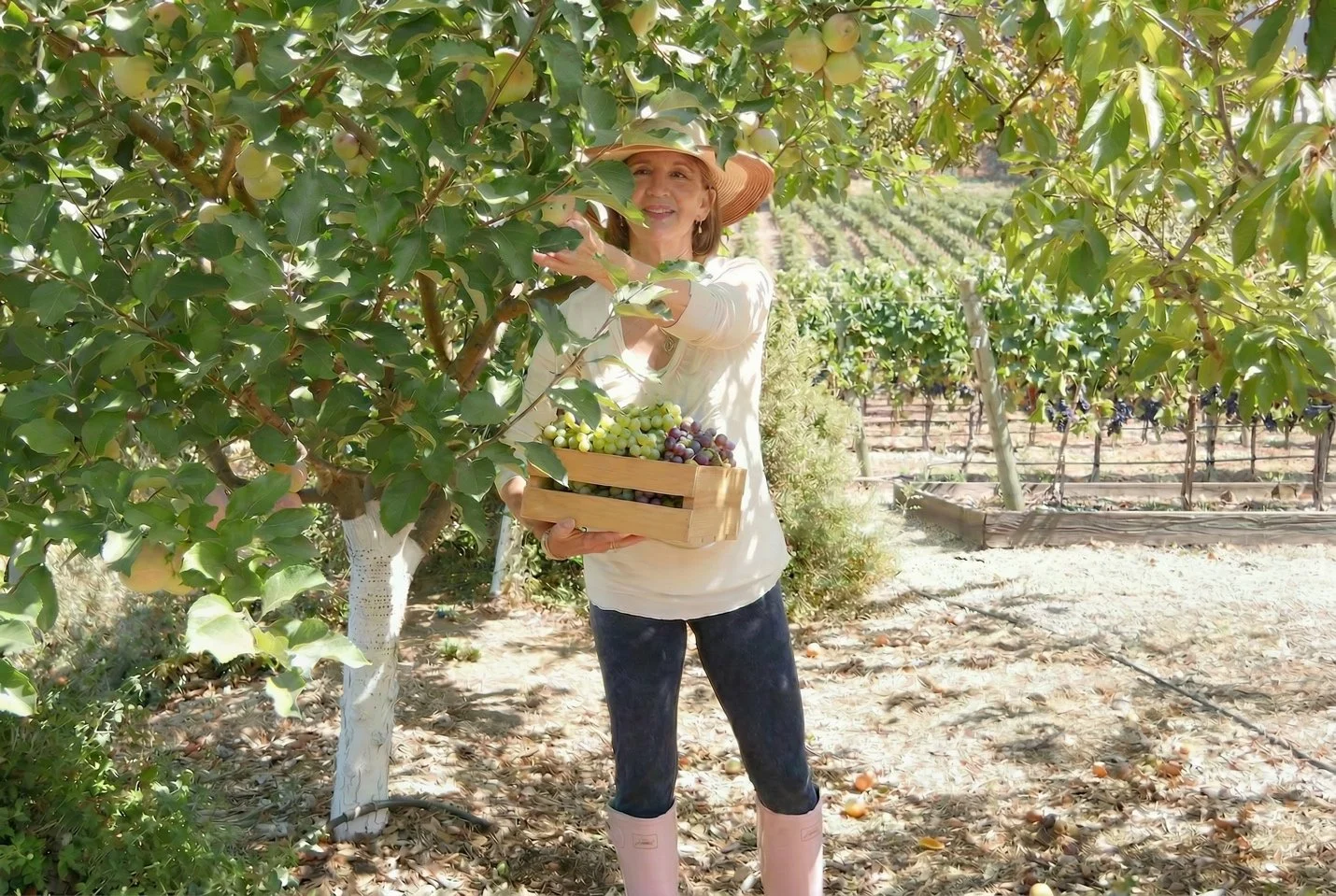
At our Certified Organic Beauty Vineyard in Sonoma County, we grow two rare grapes—Falanghina and Sagrantino—not for wine, but for their extraordinary antioxidant profiles. Working with a leading University of California grape researcher, we’ve refined our farming practices to maximize skin beneficial compounds. I believe we may be the only vineyard in the U.S. growing grapes specifically for skincare performance, not for taste, so we can tailor our growing techniques to enhance skin.
Organic farming is essential to ingredient integrity and preserving the nutrients that enrich the skin. Research shows organically grown botanicals can contain up to 30% higher antioxidant levels, and we know our grapes test at approximately 750% higher antioxidant levels than the average organically grown grape! Antioxidant-rich ingredients directly improve the ability to fight free radical damage on the skin. And beyond efficacy, organic farming protects the planet:
Reduced chemical and toxic pesticide usage —leading to less chemical runoff into waterways and soils
Biodiversity — healthier ecosystems and pollinator populations
Soil health — regenerative practices that build long‑term fertile soil
Climate benefits — organic soils sequester more carbon in soil and plants, helping to combat climate change
No GMOs — Organic ingredients are free from genetically modified organisms
Human health — fewer pesticides, no GMOs being absorbed into your skin!
Our vineyard will continue supplying ingredients exclusively for my new skincare line. It’s one of the most meaningful ways I can ensure purity, potency, and sustainability from soil to serum.
3. Are there any lessons that you have learned from past businesses that have enabled your new business to move more smoothly?
After 19 years in beauty—and more decades building health and wellness companies—I’ve learned a few things that guide me every day:
Passion is non‑negotiable. I need to be inventing ingredients and creating products that genuinely excite me. That energy fuels me to enthusiastically jump out of bed every morning.
Focus is often a learned skill for entrepreneurs. Entrepreneurs love ideas and can be easily distracted, but disciplined focus leads to better products and simpler, more effective skincare regimens.
Hyper‑customer focus is everything. Listening, asking for feedback, and staying close to the consumer are the heartbeat of any successful brand, but it’s surprising how often I see companies forget this discipline.
Protect your brand DNA fiercely. I protected my last company’s DNA for years, but after selling down to private equity and stepping away, the brand identity was lost. That will not happen again. Staying true to the brand and having people around you who truly understand the brand is essential for customer trust and long‑term success.
Self‑funding will be new for me. Without investor margin pressure, I can be more extravagant with formulations and prioritize innovation over cost‑cutting.
4. What have been the greatest challenges in getting your fourth business up and running?
At this stage in my career, I’m fortunate to have deep relationships with scientists, formulators, packaging partners, biotech experts, and more. I’m working with an incredible biotech ingredient company to invent a new ingredient derived from one of our grapes. I’ve taken my years of experience leading formulation structures with chemists and scientists, and I’m excited to be filing my fifth patent alongside my husband, who is helping me with this patent research. My husband and I own our beauty vineyard, so access to unique ingredients is literally at my fingertips.
The real challenge will be launching my initial advertising and social campaigns. After years of leading a brand with thousands of loyal customers, I know it will take time to rebuild that community from scratch. I may need to practice patience—and maybe meditation as customers build step by step!
5. What are the greatest challenges you face as a woman in the environmental space? How do you combat these challenges?
Women in sustainability often face the dual challenge of being underestimated and being expected to “prove” their expertise in ways men may not be. Environmental work—like beauty, biotech, and agriculture—has historically been male-dominated at the executive level.
I have faced these challenges by:
Leading with data and science. When your work is grounded in research, results, and measurable impact, it speaks for itself.
Inventing better products and solutions. Customers will buy ‘better’.
Building the support of women. Women supporting women is one of the most powerful forces in business. I’ve always had lots of female top leaders on my team, female networks, and of course, the support of my female best friends.
Owning my experience. Four companies, five patents, and decades of environmental leadership give me a strong foundation—and I stand firmly in it.
Women bring a unique blend of innovation, intuition, and long‑term thinking to environmental work. We also often think about the health of children and our families—key ingredients to driving meaningful change in the sustainable field. We need more of that at the table.
6. March is Women’s History Month, and EMA is excited to be able to highlight your story as an entrepreneur. Is there a particular moment that you remember when you felt the support of other women in the business sphere?
Absolutely. One defining moment, a few years ago, was when a female executive at ULTA Beauty approached me to help invent and launch their Conscious Beauty initiative and then invited me to join their founding Conscious Beauty Board of Directors. ULTA Beauty, a large publicly held company, could have turned to the big global brands—many led by men—but instead they recognized my environmental leadership and trusted me to help shape the future of clean beauty at retail.
I also felt tremendous support from my former brand’s field team, many of whom were women (alongside amazing men). Their pride in having a female founder and their passion for our mission inspired me every day and helped create amazing customer events.
Very early in my career, way back in the 1980’s, I was struggling to secure a bank loan for my second company, a Worksite Wellness Company. Despite having solid financials and big corporate clients, the male bankers kept asking me to have my husband sign for my pending loan—I wasn’t married yet—so I kept getting declined!! After winning San Francisco Entrepreneur of the Year and giving a speech with the late Dianne Feinstein, a female Bank of America manager approached me, gave me her card, and I was on my way with my first loan. She stuck her neck out to support another woman, and it paid off for both of us!
And finally, my daughter Rachel—named after the famous Rachel Carson. Years ago, Rachel Carson’s work helped ban DDT, and I so admire how she embodied fearless initiative and environmental conviction. She authored Silent Spring, a book that so greatly inspired me when I read it in the 1970’s, as it detailed how pesticides harm ecosystems and wildlife. The author and biologist endured so much criticism, much of it focused on her being female, but also because she stood up to big business and government. My daughter Rachel motivates me through her actions, her resilience, and she reminds me why this work matters.
Follow Karen on Instagram and LinkedIn to hear the latest on her big launch!