

Bad Bunny’s Music Connects Environmentalism with Puerto Rican Resistance
From winning Album of the Year at the 2026 Grammy Awards to headlining the 2026 Super Bowl halftime show, Bad Bunny is on top of the world. As the world’s #1 most-streamed artist, the singer-rapper-songwriter has made waves in the music industry with his powerful activism for immigrant rights, LGBTQ+ rights, and his homeland of Puerto Rico. His music also contains powerful themes on the environmental impacts of colonialism and gentrification.
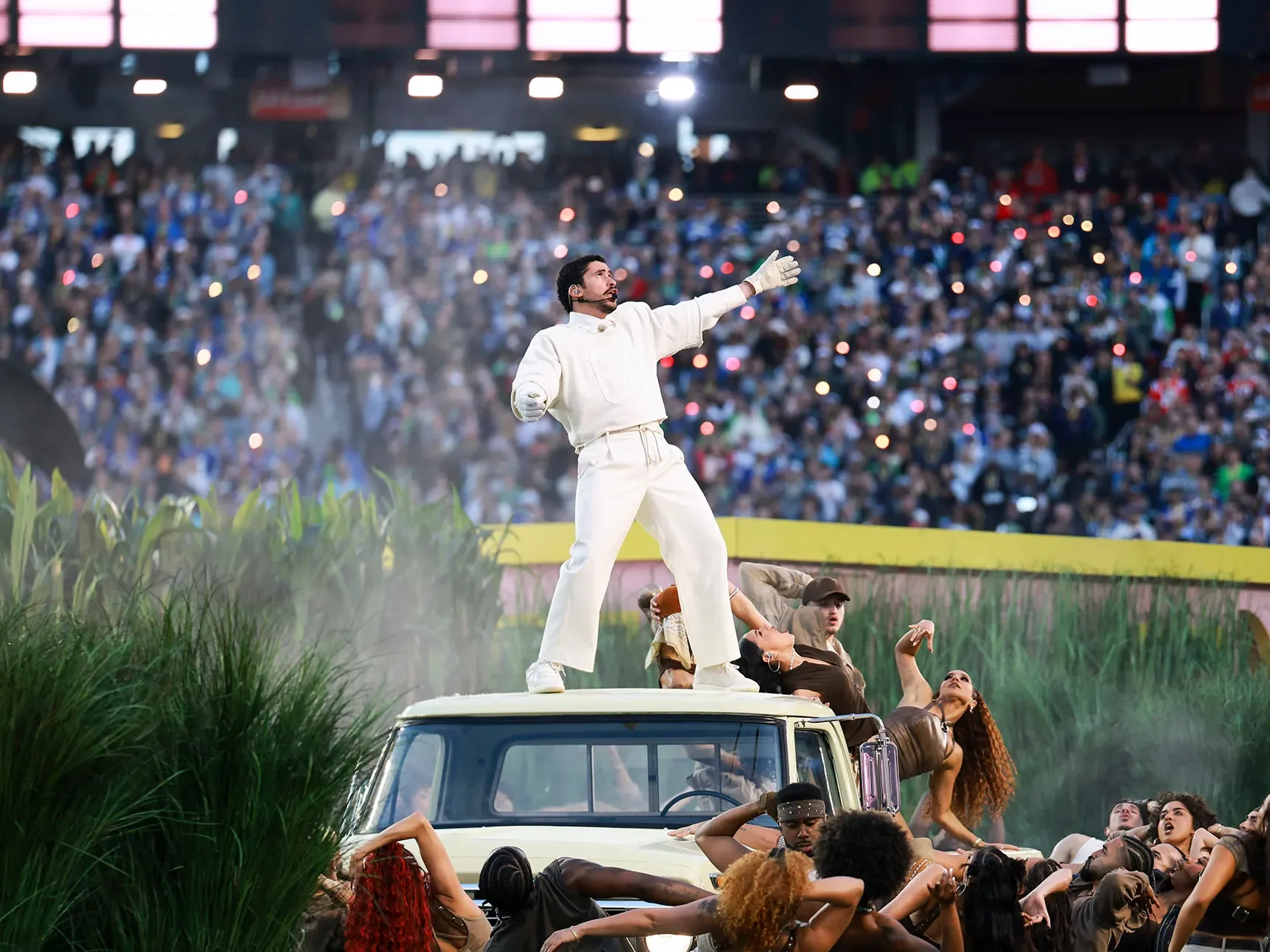
Photograph by Kathryn Riley / Getty
Gentrification and Overtourism
Across his body of work, Bad Bunny highlights how gentrification and overtourism affect local communities. In his short film DeBÍ TiRAR MáS FOToS (“I should’ve taken more photos”), an old Puerto Rican man laments the gradual decline of Puerto Rico’s culture, replaced by tourists and gentrified storefronts that are disconnected from the local Puerto Rican community. In another song, LO QUE LE PASÓ A HAWAii, Bad Bunny sings of his homeland: “I don't want them to do to you what happened to Hawaii.” Islands like Puerto Rico and Hawaii that experience gentrification and overtourism suffer various environmental impacts, including climate disasters, increased pollution from overtourism and ecosystem destruction for the construction of new buildings.
Climate Disasters and Power Outages
At the 2026 Super Bowl halftime show, dancers dangled from damaged electricity poles as Bad Bunny performed his song “El Apagón”, which means “The Blackout” in Spanish. The song references Puerto Rico’s frequent power outages, which stem from the island’s history of being hit by several hurricanes, and highlights the lack of infrastructure and support as it faces the impacts of climate change. Beyond the song, Bad Bunny also released a short documentary titled El Apagón that highlighted the unreliability of the island’s power grid and emphasized how climate disasters affect local communities.
Between 2021 and 2024, Puerto Rico lost nearly 27 hours of power per year, compared with only 2 hours in the continental U.S. In 2022, Puerto Rico experienced 200 hours of electricity interruptions, a frequent reminder of the need for climate action and adaptation. Despite the urgent need, the U.S. Department of Energy canceled $815 million of a $1 billion fund that was earmarked for strengthening Puerto Rico’s energy grid against storms and power outages.
Sugar Cane Fields and Endangered Species
From the Super Bowl stage to the DeBÍ TiRAR MáS FOToS short film, Bad Bunny’s recent works have frequently featured Concho, a sapo concho toad. Also known as Puerto Rican crested toads, sapo conchos are the only native toad species found in Puerto Rico. Unfortunately, sapo conchos are currently endangered.
These small amphibians have suffered from habitat loss due to construction and the introduction of the cane toad, an invasive species that was introduced for pest control in Puerto Rico’s colonial sugar cane fields. Notably, Bad Bunny’s Super Bowl performance and short film DeBÍ TiRAR MáS FOToS both take place in sugar cane fields, a feature characteristic of those introduced to Puerto Rico by Spanish colonizers in the mid-1500s. The inclusion of Concho and sugar cane fields in Bad Bunny’s work demonstrates how colonialism shapes economies, communities, and ecosystems, emphasizing that Puerto Rican resistance and environmental conservation go hand in hand.
Katy Ho (she/her) is a Cantonese Canadian writer, activist, and daughter of refugees who explores the intersections of gender, climate, and pop culture through her work. She is the founder of BAD ASIAN, a community that is building the discourse around Asian feminism. When she’s not writing about feminism and climate justice, you can find her hosting book club meetings, visiting her local thrift store, and checking out plant-based restaurants.