

The Pitt’s Cold Approach to a Warming Planet

Right now, almost everyone seems to be talking about HBO Max’s hit medical drama, The Pitt – and The Pitt, in turn, is talking about almost everyone. Season 1 and Season 2 embraced an exhaustive list of social issues in healthcare: medical racism, fatphobia, care delivery in rural America, abortion, treatment of veterans, child abuse, mass shootings, the trauma of COVID-19. The list goes on. As a graduate student in epidemiology, I have admired their handling of what we call “social determinants of health” – those non-medical, environmental conditions that influence patient outcomes. So where is The Pitt’s attention to the environment itself?
I realize this is the trap of many socially-conscious stories: leave out a particular issue and face the wrath of someone who hoped for, and then couldn’t find, that representation. But here, climate change is central to the plot. After all, this is a story about, among many things, the aftershocks of the acute phases of the COVID-19 pandemic. As we encroach on habitats and deplete water supplies for AI (another issue featured in Season 2) we also threaten to accelerate the emergence of the next pandemic.
The Pitt tends to be explicit in its public health lessons. In Season 2, Episode 14, the increasingly unfiltered attending physician, Dr. Robby, publicly calls out the misogyny of the EMTs who have incorrectly placed cardiac monitors on a female patient. After his announcement to the entire Emergency Department, the co-attending, Dr. Al-Hashimi, approaches him.
“I like what you said,” she says. “But [this was] maybe not the best way to do it?”
Hints at Rising Temperatures
When it comes to the environment, The Pitt’s writers seem to be taking Dr. Al-Hashimi’s advice. For a while, I wondered if The Pitt would avoid climate change altogether, but they may have simply taken a subtler approach. Season 2 takes place in July, when a heat wave is sending ripples through Pittsburgh. While Dr. Robby doesn’t have a PSA about this, the characters, and writers, respond.
In Episode 7, Dr. Langdon creates a designated cooling room to handle patients suffering from or at risk for heat-related illness. Later, in Episode 11, a pediatric patient named Micah presents with heatstroke after being trapped in a parked car.
As the care team tends to Micah, Dr. Al-Hashimi requests a pediatric body bag. There’s a moment of foreshadowed futility until viewers see her fill the bag with ice and place Micah carefully inside it. She’s practicing immersion cooling, a real technique used to treat heatstroke. In the summer of 2023, one hospital in Phoenix, Arizona, converted an area in its Emergency Department that had been previously used for COVID-19 patients into a cooling room for patients suffering from heat-related illness. Rising temperatures in The Pitt reflect a real, and growing, problem that medicine is facing: the prevention and treatment of the effects of climate change.
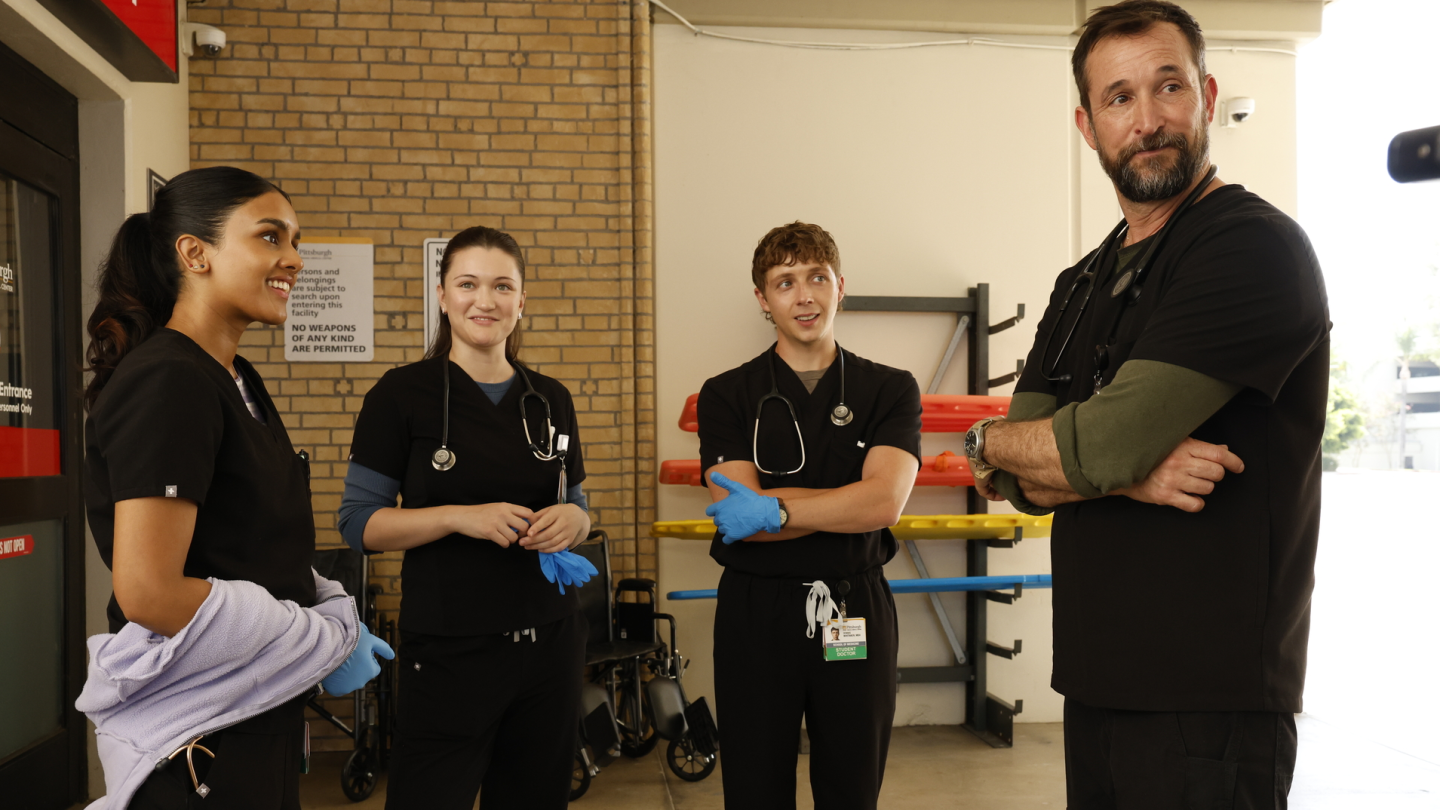
Photo by Warrick Page/Warrick Page/MAX - © MAX 2025
Climate-Informed Health Counseling
Earlier this year, I joined a meeting of the Bioethics Interest Group at George Washington University, where Prof. Peter Loge, an expert in media and public affairs, gave a lecture on political communication strategies for bridging emotional divides and connecting with those who disagree with you.
At one point, he noted that some pediatricians and primary care physicians have found roundabout ways to inform parents of the dangers of hotter summers without triggering political discourse. This is commonly called “climate-sensitive health counseling,” and while evidence is still unclear and the concept still new, it’s really an environmental add-on to the well-established norms of patient-centered communication: convey medical information while fully addressing the patient’s concerns.
In the current era of misinformation and heightened politicization of science, a number of medical societies and researchers have called for climate-sensitive health counseling and encouraged clinicians to incorporate information on climate-related health threats into the clinical encounter. Politics aside, most people still trust their own doctors. By offering objective information from a trusted source, clinicians can both protect the patient in front of them and begin to depoliticize a growing threat to public health. Some health professionals will mention increased pollen counts or higher heat indexes while avoiding terms like “climate change” altogether, in order to be as nonconfrontational – and accurate – as possible.
The Pitt is America’s Climate-Informed Clinician
I recognized this approach to climate change as I watched the most recent season of The Pitt. The writers are not ignoring a major issue, but instead, handling it with the care and caution of real medical professionals. Dr. Langdon is not conflict avoidant when it comes to climate change; he’s climate-informed, just like he might be if he were truly practicing medicine.
By refusing to engage with the politicization of climate change and treating its effects as facts that shape the story, The Pitt is acting as a climate-informed clinician for viewers. While some of us may be fortunate enough to avoid being directly impacted by other social determinants of health and therefore able to hide from them, we all live on the same feverish planet. There is no escaping that plot point.
My initial fear, when watching an otherwise socially aware show avoid direct engagement with the topic of climate change, may have been misplaced. The Pitt hasn’t placed environmentalism in a body bag because it plans to bury the issue; it did this to cool down a heated topic and keep all of us alive.
Interested in learning more about the intersection of health and the environment? Check out our IMPACT series.
Molly McGinnis is an MPH student and program coordinator in the Department of Epidemiology at The Milken Institute School of Public Health at The George Washington University. Her work has appeared in Guernica, The Sierra Nevada Review, CQ Researcher, JCO: Oncology Practice, and elsewhere.